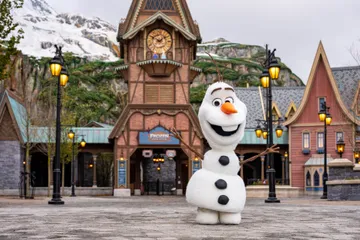
Last month Disney announced a next-generation robotic character representing Olaf, the beloved snowman from Frozen. And it wasn't a ‘coming in the distant future' innovation, the character will appear at Arendelle Bay Show in World of Frozen, the new immersive world at Disneyland Paris early next year as well as in limited-time special appearances at Hong Kong Disneyland Resort.
Olaf marks a new stage in costume character development, with the way he moves and looks crafted to reflect the curious character from the films. He even has iridescent fibers to replicate the snow-like shimmer of fresh snow catching the light.
Although the BDX droids from the Star Wars have been free roaming robotic characters and interacting with park guests for a while now, the Olaf character presents a far greater advancement. One that was acheived by using a branch of artificial intelligence called reinforcement learning. Reinforcement learning is a form of AI that allows the robot to practice thousands of movements inside a computer simulation. So instead of the time consuming task of engineers having to manually program every step, Olaf instead “learns” how to walk, balance, and gesture through trial and error until his motions replicate those seen on screen.
So we are now in a place where the speed at which theme parks can create new robotic characters and launch them is unprecedented. So does this mean the days of the traditional, person in a costume, character are numbered?
For non-human characters, like Olaf, and others such as Mickey, Donald, Sully, Winnie the Pooh and Stitch the new robotic characters arguably offer a much better experience, many of these characters are ‘mute’ in the parks unable to speak, whereas this new technology will bring them to life in an even more realistic way. For Olaf they also allow the moving character to be at the relative scale he is seen in the films, much smaller than humans, rather than the larger size he has to be as a traditional costume character.
For human based characters like the Disney Princesses, Peter Pan or Hercules, it's difficult to see how an animatronic could beat a real person dressed up, particularly as these characters are allowed to speak and interact openly with guests. However the pace of technology is such that it could be just a matter of time.
Outside of theme parks, and the revenue generated from ticket sales though, the much cheaper traditional costume character is likely to be around for a long time to come. At retailers, shopping malls and film screening events the cost of non-human characters is likely to always be prohibitive. Which could lead to a much bigger difference being created between the in and outside theme park costume character experience.
So what do you think? Do traditional costume characters have a natural charm that is difficult to replicate? Or are animatronic costumes they way forward?